Mothers Day
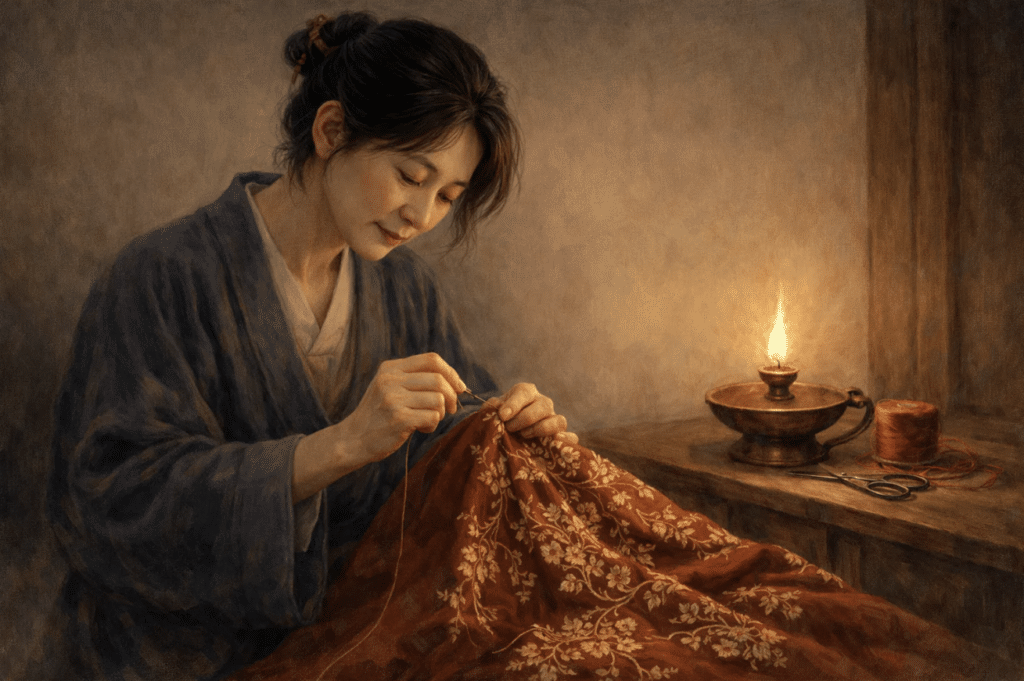
Crédit : poems.mahacinasthana.com
《遊子吟》 Song of A Travelling Son
慈母手中线,游子身上衣。 Thread in the hands of a loving mother
Turns to clothes on the traveling son.
临行密密缝,意恐迟迟归。 She adds stitch after tight stitch until he leaves
and worries about his return.
谁言寸草心,报得三春晖。 A grass blade is bathed in spring sun;
how can its inch-sized heart return such love?
Crédit : chinese-shortstories.com
A Few Explainations
A Few Personal Reflections
Meng Jiao (751–814), a poet of the Tang dynasty (618–907), conveyed love in its purest and most profound dimension: the love of a mother for her son. In six lines and thirty characters, he captures its entire majesty. This poem ranks among the most celebrated in Chinese literature; it is learnt by heart by every child, recited from generation to generation, cherished as an intimate and universal legacy at once.
Born in Zhejiang province, Meng Jiao endured a life of frugality. He succeeded in the imperial examinations only at the age of forty-six, and led a modest, unadorned existence thereafter. His poems, like his destiny, are distinguished by a rare precision: no ornament, no affectation — every word bears the weight of necessity.
In The Ballad of the Traveller — which I prefer to call Song of the Child Departing — the very first line offers a sovereign example of this concision: a thread, a loving mother. And this thread, the humblest of threads, leads us towards a truth as limpid as it is inexorable: no gratitude could ever equal a mother’s love, just as the tender blade of grass can never repay the three months of spring sunshine of the final line. The simple thread suddenly places us before immensity.
And yet, this mother endures torment: stitching the tunic so that her beloved son may depart — for a distant examination, for a new post — but when will he return?
Meng Jiao, ordinarily so sparing of any superfluous word, dares a deliberate repetition here: ‘close, close’ 密密 and ‘late, late’ 迟迟 in the third and fourth lines. He who was called cold, he whom hardship had hardened, here allows himself to be overcome by emotion, so much so that he introduces, perhaps, the resonance of a nursery song. But the emotion never overflows: it remains contained, as if knotted into the thread. This tightly drawn thread — is it not the mother’s very heart, suspended upon the uncertainty of return?
We encounter this very intuition of the boundlessness of a mother’s love in the pen of Sully Prudhomme (1839–1907):
…
Qui de nous peut dire où commence,
Où finit l’amour maternel ?
Who among us can truly tell
Where a mother’s love begins, or ends, its tender spell?
…
Let us observe, finally, that this condensed, crystalline form, in which brevity becomes depth, would find its fullest flowering in seventeenth-century Japan with the art of the haiku. Though the metre differs — five, seven, five syllables for the haiku, four groups of five characters for Meng Jiao — the place accorded to the season, that great breath of the world, remains a constant. In Meng Jiao’s poem, it is spring that seals the verse.